
Reviewed · WALKING TOURS
Boston’s Freedom Trail: A Revolutionary Walking Tour
Boston’s Freedom Trail is more than a red line through downtown. It is a compact lesson in rebellion, protest, faith, commerce, and the messy work of building a country. This tour links all 16 official sites in about two and a half hours, from The Embrace near Boston Common to Copp’s Hill Terrace in the North End.
I like the way the route mixes famous names with less expected stories, including abolitionist speeches, immigrant life, women’s rights, and the people behind Boston’s public buildings. I also like the strong storytelling from guides such as Kenny, Alissa, Jim, Julia, Alfred, and Charles R., who bring humor and detail to the walk. The main catch is simple: you cover a lot of ground quickly, and some people may find the pace tough.
- The complete trail in one walk: Visit all 16 official Freedom Trail sites, including burial grounds, churches, meeting halls, and historic houses.
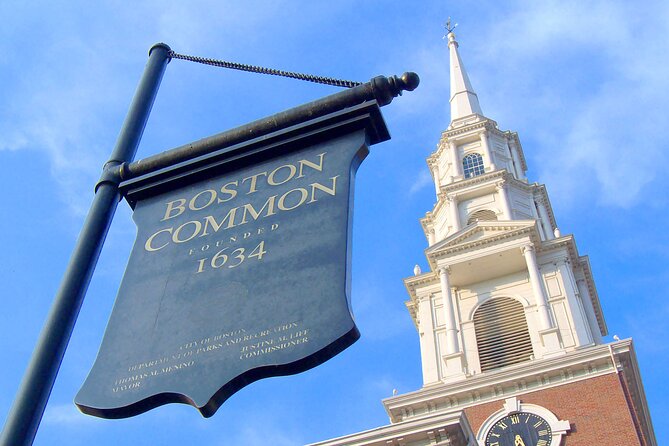
- A strong starting point: Begin at The Embrace beside the Boston Common Visitor Information Center.
- Revolutionary Boston in context: Connect the Boston Massacre, Tea Party, Paul Revere’s ride, and the Battle of Bunker Hill.
- More than military history: Hear about abolition, women’s rights, education, immigration, and Boston’s four-century story.
- A memorable finish: End at Copp’s Hill Terrace with views toward Bunker Hill Monument and USS Constitution.
- A practical group size: The tour accepts a maximum of 25 people, though hearing the guide can still depend on where you stand.
Starting with The Embrace near Boston Common
The walk begins at The Embrace, the recent memorial to Martin Luther King Jr. and Coretta Scott King. It sits beside the Boston Common Visitor Information Center at 139 Tremont Street, making this a useful place to meet and get oriented.
Beginning here gives the tour a broader frame than a simple march through Revolutionary War sites. Boston’s story did not stop in 1775 or 1783. The opening point connects the city’s colonial past with later struggles for civil rights and equality.
From here, you move toward the Massachusetts State House. Its golden dome is one of Boston’s most recognizable sights, but the useful part of the stop is the reminder that Massachusetts government took shape while the new nation was still finding its footing. Samuel Adams laid the cornerstone of the State House in 1795.
The early part of the walk gives you a sense of Boston’s age and density. Historic buildings sit close together, streets can be busy, and the modern city continues around the old sites. The guide’s job is to make those layers readable.
Churches, abolition, and the city’s moral arguments

One stop features a red brick church built in 1809. Its congregation included abolitionists, and speeches against slavery were delivered inside. This is an important counterweight to a tour focused only on Paul Revere and British troops.
I value this part because it shows that Boston’s public life involved arguments over freedom long after independence. The same city that celebrated liberty also had to confront slavery, discrimination, and unequal rights.
You also visit the stone church built in 1754, the first Anglican Church in Boston. Its construction, neighboring burying ground, and underground crypts add a darker and more intimate layer to the walk. The tour does not treat churches as pretty backdrops. They were places of worship, power, debate, burial, and sometimes conflict.
Some stops are viewed from outside, so you should not book this expecting a series of extended indoor visits. The reward is the guide’s explanation of what happened at each location and why the building mattered.
Other walks around Boston:
- Boston: Freedom Trail History Small Group Walking Tour
★ 5.0 · 6,450 reviews - Cambridge: Harvard University Student-Guided Walking Tour
★ 4.6 · 3,931 reviews - Harvard University Campus Guided Walking Tour
★ 4.5 · 3,632 reviews
Granary Burying Ground and Boston’s famous names
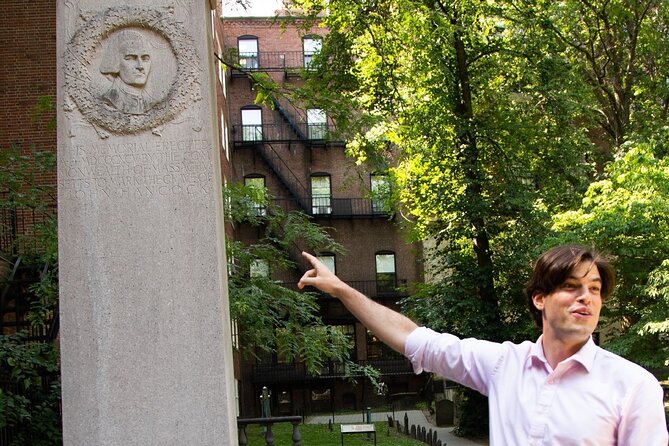
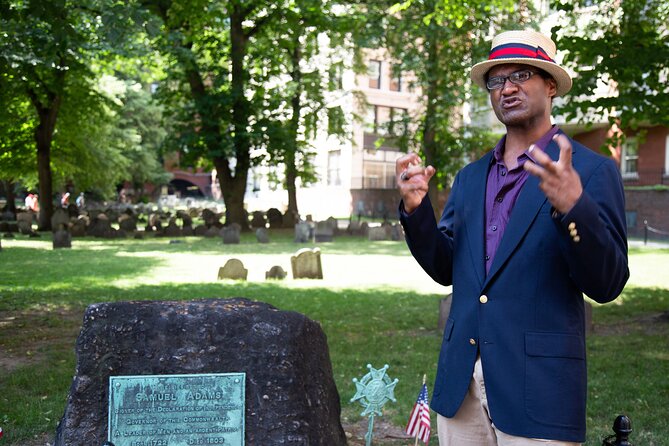
Granary Burying Ground dates to 1660 and contains the graves of major figures in the American Revolution, including John Hancock, Paul Revere, and Samuel Adams. This is one of the most concentrated historic stops on the route.
A cemetery can slow the pace of a walking tour, and here that is both a strength and a possible weakness. The details about the people buried here are useful, but one recent participant felt the guide spent too long in the cemetery while the rest of the group later had to hurry.
If you have a walking stick, limited stamina, or trouble hearing in a moving group, this is worth considering. The tour requires a moderate level of physical fitness, and you may need to tell the guide if you need a slower pace or a better position for hearing.
Still, the burial ground gives the Revolution human scale. These are not just names on plaques. You are standing among the people who shaped Massachusetts politics, commerce, and the colonial resistance.
The Old South Meeting House and the Boston Tea Party
The Old South Meeting House, built in 1729, is where the Boston Tea Party began. The tour explains how a Puritan meeting house became a gathering point for political protest and civil disobedience.
This stop matters because the Tea Party was not a spontaneous bit of destruction. It grew out of meetings, speeches, anger over taxation, and a sense that ordinary colonists had been pushed too far. If you want a fuller account of the night itself, ask your guide specific questions about how many people took part and what happened afterward.
The route also includes a 1718 brick building that once belonged to a colonial apothecary and later housed the publishing firm Ticknor & Fields. That stop shifts the story from rebellion to literature, showing how Boston’s importance continued into the nineteenth century.
It is an easy detail to miss if you walk the trail alone. With a guide, an unassuming brick building becomes part of the city’s cultural story.
The Old State House and the Boston Massacre
The Old State House was built in 1713 and once served as the center of British government in Massachusetts. Its exterior carries symbols of Great Britain, including a lion and unicorn, while its interior was associated with speeches and confrontations that helped push the colony toward revolt.
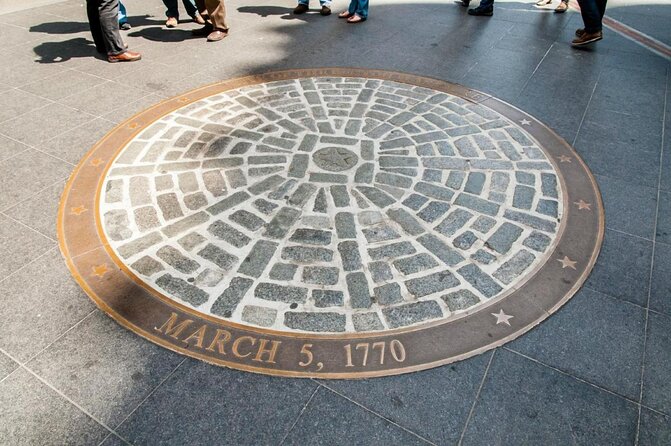
Nearby, a circle of stones marks the site of the Boston Massacre in 1770. The guide reconstructs the event moment by moment, including the musket fire that killed five colonists.
This is one of the places where a good guide makes a real difference. The basic facts are familiar, but the meaning of the event depended on how it was presented to the public. The killing became a powerful political tool, and the story helps explain how tension with British troops turned into a wider movement.
The area can be crowded, and city noise may make it hard to hear every word. One useful tip from the tour feedback is to stay close and keep facing the guide. In a larger group, the company would benefit from a louder speaker, and your position can affect how much you take in.
Same base, a different kind of day out:
- Boston Duck Boat Sightseeing City Tour with Cruise Along Charles River
★ 4.5 · 9,378 reviews - Boston Hop-On Hop-Off Trolley Tour with 13 Stops
★ 4.5 · 5,576 reviews - Boston: City Cruises Whale Watching Cruise
★ 4.5 · 4,710 reviews - Boston Duck Tour: The Original and World-Famous
★ 4.6 · 3,935 reviews
Faneuil Hall and the public voice of Boston
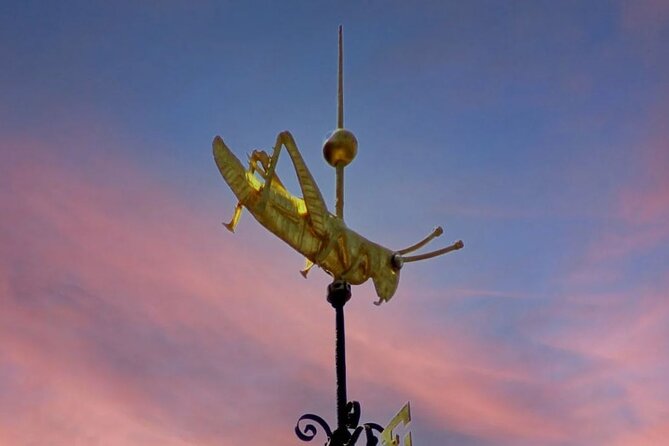
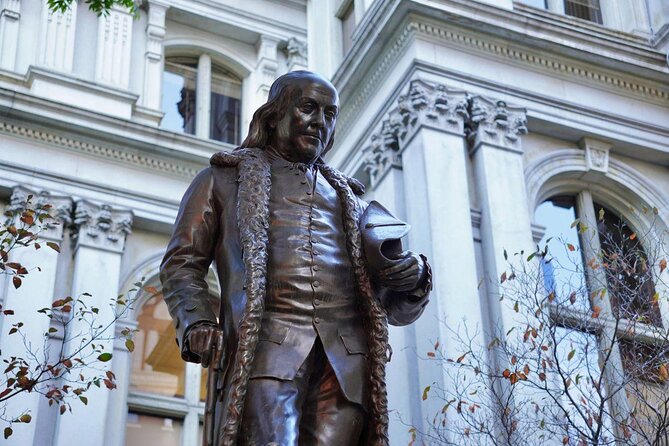
Faneuil Hall began as a marketplace in 1743, but its upstairs meeting hall became more important. Known as the Cradle of Liberty, it hosted speeches that helped shape Boston’s political identity.
This is a good example of how the tour handles history. A market building becomes a political forum. Commerce and protest shared the same city blocks, and public opinion grew through meetings, arguments, and speeches.
The stop also helps explain why Boston’s revolution was not simply a story of famous men making secret plans. Political change depended on public gatherings and persuasive words. You get more from the site when you listen for that connection.
The tour’s route through downtown is efficient, but not leisurely. You will stop often, then move on to the next site. Wear comfortable shoes and expect a solid amount of walking.
Paul Revere’s house and the North End
Paul Revere’s House dates to 1680 and is the oldest building in Boston. Revere lived there with his family, and the house gives the tour a more domestic setting after the grand civic buildings downtown.
I like this stop because it places a famous patriot in an ordinary home. Revolutionary history can become too polished when it focuses only on statues and heroic names. A family house brings daily life back into view.
The North End also changes the feel of the walk. The route grows more residential and intimate as it moves away from the broad civic spaces near Boston Common. You continue hearing about revolution, but the surroundings make the story feel closer to the people who lived through it.
The tour does not promise extended time inside every building, so check your expectations. The value here comes from seeing the house as part of the route and hearing how Revere’s home connected to his family life and public actions.
Old North Church and the lantern signal
Old North Church was built in 1723. Its steeple became famous on April 18, 1775, when two lanterns signaled that British forces were moving by sea. The guide explains how Paul Revere arranged the signal and why it mattered on the eve of the Revolution.
This is one of the best-known Freedom Trail stories, but it works because the tour places it beside the other stops. The signal was not an isolated act of legend. It belonged to a tense network of warnings, movement, and preparation.
The tour’s storytelling is often at its best at moments like this. Guides including Alissa, Kenny, Jim, and Alfred have been praised for combining facts with humor and clear explanations. That style can keep teenagers and adults engaged, especially when the subject is familiar.
Copp’s Hill, Bunker Hill, and USS Constitution
The final section reaches Copp’s Hill Burying Ground, which dates to 1660. During the Battle of Bunker Hill, British forces placed cannon here. The cemetery also contains the graves of notable Bostonians.
From Copp’s Hill Terrace, you can view the 221-foot Bunker Hill Monument. The monument marks the location where colonial militia defended hastily built earthworks and repelled two British attacks before retreating.
The tour ends with a view toward the masts and rigging of USS Constitution in Charlestown. Known as Old Ironsides, it won pitched battles in the War of 1812 and is the oldest warship afloat anywhere in the world.
This ending is well chosen. It ties the walk to the larger harbor and to the military story that followed the Revolution. You finish in Boston’s historic North End at Copp’s Hill Terrace, near 7 Jackson Avenue, with two major sights in view across the water.
How the pace and group size affect the experience
The tour lasts about two hours and 30 minutes and allows up to 25 people. That is small enough to feel more personal than a huge city group, but it is still large enough for hearing and positioning to matter.
The strongest guides keep the walk moving without making it feel like a race. Julia, Alissa, Charles R., and Jim have been singled out for clear delivery and good pacing, while Kenny and Alfred have been praised for answering questions and keeping groups engaged.
The experience is weather dependent. Boston’s weather can change quickly, and the tour may be moved or refunded if conditions make it unsuitable. You also get free cancellation if you cancel at least 24 hours before the start time. Changes or cancellations made later are not accepted.
Book this early if your schedule is tight. The experience is usually reserved about 12 days ahead, which suggests that popular dates can fill before arrival.
Is the $31 price good value?
At $31 per person, this is a reasonable price for a guided walk covering the full Freedom Trail. You are paying for the route planning, historical explanation, and the ability to connect sites that can feel scattered when seen alone.
Walking the trail independently costs less, but the savings come with a tradeoff. You must identify the sites, understand their importance, and decide how the Revolution fits into Boston’s later stories of abolition, rights, education, and immigration.
The tour is strongest if you want one organized introduction to Boston. It is less suited to you if you prefer to linger inside buildings, take long photo breaks, or explore at your own pace.
Who should book this Freedom Trail walk?
I would choose this tour for a first visit, a family with older children, a history-minded couple, or anyone who wants a clear orientation to downtown Boston. It also works well at the start of a trip because you finish knowing which buildings and neighborhoods deserve a second look.
The tour suits people who enjoy stories more than silent sightseeing. Guides such as Noah have kept teenagers interested, while other guides have handled detailed questions from serious history fans.
I would think twice if you have difficulty walking for two and a half hours, need frequent rest stops, or struggle to hear in a group. The walk is manageable for many people, but the route covers several miles and the pace can become quick between stops.
Should you book it?
Book it if you want to see all 16 official Freedom Trail sites in one organized outing and learn how they connect. The strongest reasons are the broad subject range, the skilled storytelling, and the memorable finish at Copp’s Hill with views of Bunker Hill Monument and USS Constitution.
Skip it if you want a slow museum-style visit or plan to explore every site indoors. For most first-time visitors who can handle a steady walk, $31 is a fair price for a lively introduction to Boston’s Revolution and the larger story of the city.
FAQ
How long is the Freedom Trail walking tour?
The tour lasts approximately two hours and 30 minutes.
Where does the tour begin?
It begins at The Embrace, beside the Boston Common Visitor Information Center at 139 Tremont Street in Boston.
Where does the tour end?
The tour ends at Copp’s Hill Terrace in Boston’s historic North End, near 7 Jackson Avenue. You can see Bunker Hill Monument and USS Constitution from the ending point.
Does the tour visit all of the Freedom Trail sites?
The tour is designed to cover all 16 official sites of Boston’s Freedom Trail.
What language is the tour offered in?
The tour is offered in English.
How many people can join the tour?
The maximum group size is 25 people.
Can I cancel for a refund?
Yes. You can cancel at least 24 hours before the start time for a full refund. If poor weather causes the company to cancel, you will be offered another date or a full refund.
Just added in Boston
- Delicious Donuts of Boston: A Sweet History Walking Tour★ 5.0 · 1,038 reviews
- Sunset Sailing Cruise on a Tall Ship in Boston Harbor★ 4.5 · 414 reviews
- Boston North End Food Tour of 6+ Tastings, Cannoli, Lobster Roll★ 5.0 · 1,404 reviews
- Freedom Trail Walking Tour 250★ 4.5 · 1,118 reviews
- Boston’s North End Food and History Walking Tour★ 5.0 · 459 reviews
- Narrated Sunset Cruise of Boston Harbor★ 4.0 · 532 reviews
- City Cruises Salem High Speed Ferry to/from Boston★ 4.5 · 727 reviews
- New England Aquarium Admission Ticket in Boston★ 4.0 · 446 reviews
Walking Tours, compared.
New Orleans Premier Ghost, Voodoo and Vampire Walking Tour
Read our review →

Freedom Trail History Small Group Walking Tour
Read our review →
Historic Charleston Guided Sightseeing Walking Tour
Read our review →
New Orleans Food Walking Tour of the French Quarter with Small-Group Option
Read our review →
St. Louis Cemetery No. 1 Official Walking Tour
Read our review →
Harvard University Student-Guided Walking Tour
Read our review →
Harvard University Campus Guided Walking Tour
Read our review →Browse the lists this tour appears in