
Reviewed · WALKING TOURS
Birmingham Civil Rights Tour- Riding & Walking
Birmingham’s civil rights story comes into focus when you move between the places where it happened. This tour takes you from Kelly Ingram Park and 16th Street Baptist Church to Dynamite Hill, Bethel Baptist Church, and the site of the Freedom Riders attack, linking each location with the people and events that shaped the city.
I like the mix of van time and walking, since Birmingham’s key sites are spread out. I also like the small maximum of 14 people. Guides Mike and Clay are praised for clear storytelling, historical detail, and thoughtful answers. The main drawback is the physical demand: you’ll walk more than a mile outdoors, sometimes in temperatures from 40 to 100 degrees Fahrenheit.
Key points
- Walk through Kelly Ingram Park, where statues and memorials help explain the marches and police violence of Birmingham’s civil rights era.
- See 16th Street Baptist Church, the site of the 1963 bombing that killed four girls.
- Travel beyond downtown, reaching Dynamite Hill, Bethel Baptist Church, and neighborhoods often missed on a basic city tour.
- Learn from Mike or Clay, guides praised for chronological storytelling, local knowledge, and a willingness to address painful subjects directly.
- Ride in an air-conditioned vehicle between stops, with entrance fees, taxes, and transportation included.
- Expect a serious, emotional experience, not a light sightseeing loop.
Why Birmingham’s civil rights story works best on the move
You can visit Birmingham’s Civil Rights District on your own, but the geography does not explain itself. A church, park, auditorium, school, and downtown street may look ordinary until you understand what happened there. This tour gives you that missing connection.
The route begins at 512 16th Street North at 9:45 a.m. and returns to the same meeting point. From there, you move between central sites by air-conditioned vehicle, then get out for short walks and close looks at important places.
That format matters. The tour does not keep you inside a van pointing at landmarks through a window, but it also does not ask you to walk across Birmingham in the heat. You get enough time on foot to see statues, buildings, and street corners, with the vehicle covering the longer stretches.
The group limit of 14 makes it easier to hear the guide and ask questions. If the group is small, the experience can feel nearly private. One couple described having a private tour when they were the only participants that day, though you should not count on that happening.
Other walks around the USA:
- History and Hauntings of Salem Guided Walking Tour
★ 5.0 · 14,564 reviews - New Orleans Premier Ghost, Voodoo and Vampire Walking Tour
★ 4.5 · 12,856 reviews - Little Havana Food and Walking Tour in Miami
★ 5.0 · 8,882 reviews
What Mike and Clay bring to the tour
The guide is central to this experience. Mike and Clay are repeatedly praised for presenting Birmingham’s civil rights story in a clear order, rather than tossing out disconnected names and dates.
Mike is described as a Birmingham native with a strong grasp of the city’s past. His approach includes stories about major leaders, local residents, children, churches, business owners, and people whose names are less familiar. That wider focus is important because Birmingham’s struggle was not carried by famous figures alone.
Clay is also praised for detailed explanations and strong command of the subject. Both guides are described as willing to answer questions and handle painful topics with care. You should expect frank discussion of racism, bombings, police violence, segregation, school integration, and the cost paid by people who challenged the system.
The presentation is not polished into something comfortable. That is a strength here. Several stops are disturbing, and the guide does not soften the events simply to make the tour easier. At the same time, the tone is not hopeless. Stories of courage, organizing, religious leadership, and small gains keep the experience from becoming only a catalog of tragedy.
If you are bringing teenagers, the tour can work well, provided they are ready for serious material. A parent described the guide as adjusting explanations for children and keeping young people engaged. Children must be accompanied by an adult.
Kelly Ingram Park and the Civil Rights District
The first part of the tour centers on Birmingham’s Civil Rights District. You walk through Kelly Ingram Park, see 16th Street Baptist Church, and begin placing the local movement in its setting.
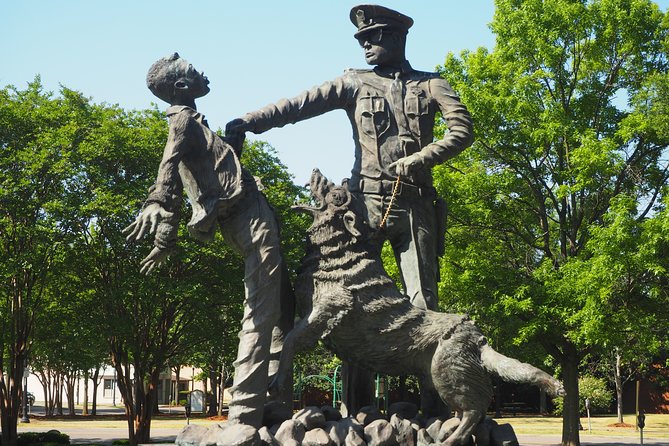
Kelly Ingram Park is especially useful as an opening stop because its statues show the human side of the movement. The park is not just a patch of downtown green space. It recalls the children and adults who marched, the brutality used against them, and the courage required to keep going.
Plan to spend about 30 minutes in this area, then another 30 minutes walking around Kelly Ingram Park and examining its memorials. The schedule lists the district, park, and church as separate stops, but they form one connected experience. You should expect the guide to build the story in layers rather than treat each place as an isolated attraction.
The walking here is manageable for most people who can move at a reasonable pace, but it is still outdoor walking. Shade and rest pauses may be available, depending on conditions and the guide’s judgment. Wear practical shoes and bring water.
16th Street Baptist Church and the four girls
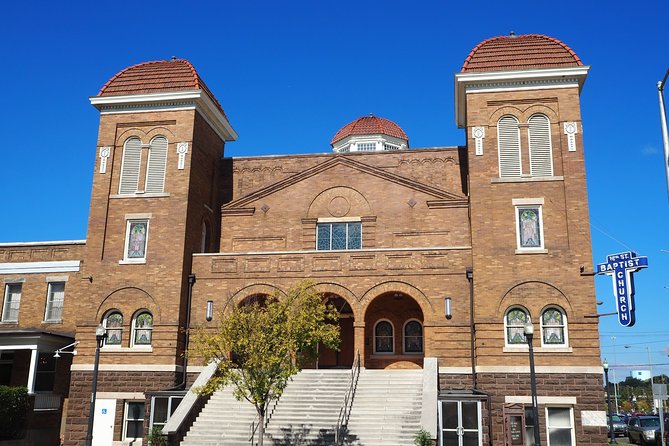
The church is one of the most important stops of the morning. The guide explains its role as a meeting place and organizing center during Birmingham’s civil rights campaign, then recounts the bombing that killed four girls.
This is a place where the facts can feel especially heavy because the building is tied to both worship and activism. The church was not simply a backdrop to the movement. It played an active role in the work of people challenging segregation.
Expect about 30 minutes here. The supplied details do not promise an interior visit, so you should think of this as a stop to understand the church’s importance and the bombing’s consequences, rather than assume a full building tour. Entrance fees are included, though all listed stops show free admission.
The guide’s role matters most here. A quick photo stop would miss the point. Mike and Clay are praised for adding context, answering questions, and explaining how the attack affected Birmingham and the wider civil rights struggle.
Same base, a different kind of day out:
- NYC: SUMMIT One Vanderbilt Tickets
★ 4.7 · 51,195 reviews - NYC: 9/11 Memorial & Museum Timed-Entry Ticket
★ 4.8 · 31,428 reviews - NYC: Empire State Building Tickets – Observatory & Museum
★ 4.7 · 25,757 reviews - NYC: Empire State Building Observation Deck Tickets
★ 4.7 · 22,072 reviews
Linn Park and Boutwell Auditorium
The route then moves to Linn Park, where marches ended, and Boutwell Auditorium, connected to Birmingham’s political conflicts during the movement.
At Linn Park, you learn how demonstrations moved through the city and where people gathered at the end of a march. That helps you picture the scale and public nature of the protests. The stop is scheduled for about 15 minutes, so expect a focused explanation rather than a long walk.
Boutwell Auditorium adds the local government side of the story. Here, the guide discusses Bull Connor and his clashes with those fighting for civil rights. The stop lasts about 15 minutes and gives you a better sense of how city power opposed the movement.
These brief stops work because the tour is not trying to turn every location into a full museum visit. You get the key connection, then move on. If you prefer long periods at one site, the pace may feel brisk. If you want to understand how the places fit together, the rhythm is useful.
Dynamite Hill in Smithfield
The ride to Smithfield takes you away from the most familiar downtown landmarks. At Dynamite Hill, you see houses and churches that were bombed during the civil rights era.
This stop expands the story beyond public demonstrations. Bombings were meant to frighten Black families, churches, and organizers into silence. Seeing the neighborhood helps you understand that the movement was fought in residential streets as well as in parks, churches, and government buildings.
The stop is scheduled for about 15 minutes. You will not be spending hours walking through the neighborhood, but the short visit gives the guide a chance to explain the pattern of attacks and the pressure placed on local residents.
This is one of the reasons I would choose this tour over a simple downtown walk. Dynamite Hill is not part of the standard first-time Birmingham stroll, yet it shows how the movement affected daily life. Stay respectful and listen carefully. This is a residential area tied to painful events, not a photo backdrop.
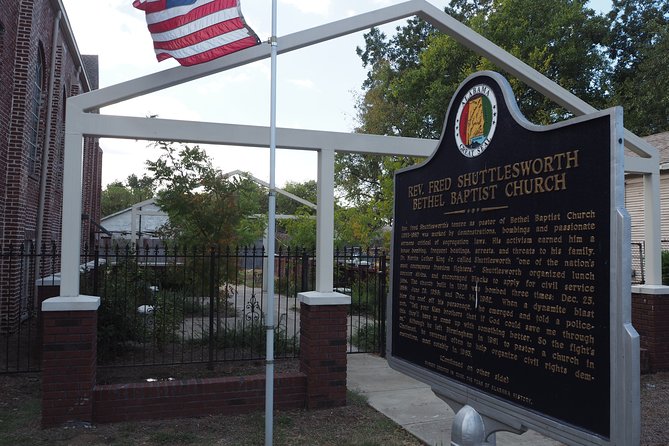
Bethel Baptist Church and Rev. Fred Shuttlesworth
At Historic Bethel Baptist Church, the tour focuses on Rev. Fred Shuttlesworth and the role he played in Birmingham’s movement. You spend about 20 minutes here.
The church gives the tour a strong sense of leadership and organization. The civil rights campaign required more than marches. It depended on churches, meetings, planning, courage, and people willing to risk their safety over a long period.
The guide also discusses Shuttlesworth’s work at John Herbert Phillips Academy, where he attempted to integrate Birmingham schools. That later stop lasts about 15 minutes and adds another piece to the struggle: the fight was not limited to public accommodations. Education was also a major battleground.
Together, Bethel Baptist Church and the academy show how local activism reached into religious life, schools, neighborhoods, and city politics. The short time at each place means the guide must choose the most useful details. You can ask questions if you want to explore a particular person or event further.
Eddie Kendrick Memorial Park and Black Birmingham
Eddie Kendrick Memorial Park is a brief five-minute stop connected to Birmingham’s Black business district. The visit is short, but the subject adds needed balance to a route focused on violence and protest.
You learn about Black life and business in Birmingham during its heyday. This matters because Black communities were not defined only by segregation and resistance. They built businesses, institutions, churches, and social networks under difficult conditions.
The stop helps you see the movement as a fight to protect and expand a full community life, not only a campaign against specific laws. It also gives the tour a little breathing room between the heavier stories of bombings, attacks, and school integration.
Because the stop is only five minutes, do not expect a long walk or extensive exploration. Its value comes from the guide’s explanation and from seeing how the business district fits into the wider story.
The Freedom Riders attack site
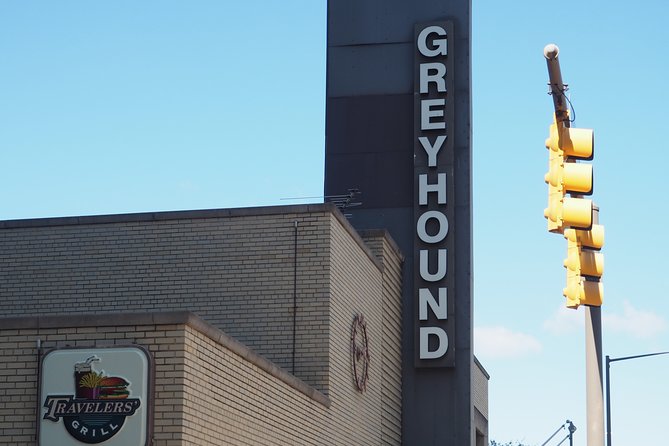
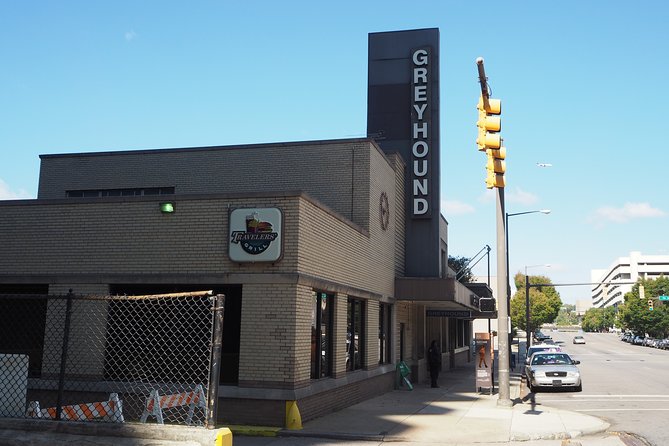
The final major stop is the location of the 1961 Freedom Riders attack, now identified near a Wells Fargo ATM. The visit lasts about 10 minutes.
The setting may look modern and unremarkable, which is precisely why a guide is useful. Without context, you could pass the spot without realizing its importance. The tour connects the present-day location to the violence faced by Freedom Riders in Birmingham.
This stop broadens the timeline beyond the best-known events of 1963. You learn that the city’s civil rights struggle developed over several years and involved interstate travel, public transportation, federal pressure, local resistance, and organized violence.
The tour returns to the original meeting point after this stop. Since the route is described as approximately three hours, the exact pace may vary with group size, questions, traffic, and weather.
Riding, walking, and handling Birmingham weather
The physical plan is simple: walk over a mile in total and ride between sites in an air-conditioned vehicle. That is a sensible arrangement for Birmingham, where summer heat can make an all-day walking tour unpleasant.
You need to walk unassisted at a reasonable speed. The experience is not recommended for anyone unable to walk at least a mile or anyone strongly affected by heat or cold. Temperatures may range from 40 to 100 degrees Fahrenheit, so check the forecast and dress for the conditions.
The tour runs in rain. If rain becomes a problem, transportation is available, but the experience is still designed around outdoor stops. Significant weather such as a hurricane, tornado, or ice can lead to cancellation, with a choice of another date or a full refund.
Bring water, wear comfortable shoes, and consider sun protection in warm weather. Since the tour begins at 9:45 a.m., the morning start helps avoid the hottest part of many summer days, though it does not remove the need to prepare.
What is included and what that means for value
The advertised price is not provided here, so I cannot judge it against a specific dollar amount. I can judge what you receive for the fee: an approximately three-hour guided route, air-conditioned transportation, live commentary, all activities, entrance fees, and taxes, fees, and handling charges.
That package has practical value. You avoid arranging several separate rides, figuring out how to reach Smithfield, or paying surprise admission charges. You also avoid the time cost of getting lost between downtown and the farther stops.
The small group adds value if you want to ask questions. A large bus tour can cover the same broad subject, but it often leaves little room for conversation. Here, the group maximum is 14, and the guide can respond to the interests of the people in the vehicle.
The strongest value is interpretive. You are not paying only for transportation. You are paying for someone to connect a park, church, school, neighborhood, and street corner into one understandable story.
Who should book this experience
I would choose this tour if you are visiting Birmingham specifically to understand its civil rights past. It suits first-time visitors, history students, families with older children, teachers, and anyone who wants more context than a self-guided walk provides.
It is also a good choice if you have limited time. Three hours covers several locations that would be awkward to reach independently, especially Dynamite Hill, Bethel Baptist Church, the school, and the Freedom Riders attack site.
You should think twice if you want a relaxed sightseeing outing with little walking or light subject matter. This tour deals directly with bombings, racial violence, segregation, and the deaths of children. It can be moving and upsetting.
The experience may also be less suitable if you have mobility limits, struggle with heat or cold, or need a slower walking pace. The air-conditioned vehicle helps, but it does not remove the walking requirement.
Booking, cancellation, and meeting details
You meet at 512 16th Street North, Birmingham, Alabama 35203, at 9:45 a.m. The tour ends back at the same location. Confirmation is provided when you book, and service animals are allowed.
Free cancellation is available up to 24 hours before the start time. Cancel within 24 hours, or request a change within that period, and you will not receive a refund.
The tour is operated by Red Clay Enterprises LLC. It runs in ordinary rain, but significant weather can cause cancellation. In that case, you are offered another date or a full refund.
Should you book the Birmingham Civil Rights Tour?
Book it if you want Birmingham’s civil rights story explained by a local guide who can connect famous landmarks with less familiar neighborhoods and events. The combination of Kelly Ingram Park, 16th Street Baptist Church, Dynamite Hill, Bethel Baptist Church, the school, and the Freedom Riders site gives you far more than a downtown sightseeing loop.
I especially like the balance of riding and walking, the maximum group size of 14, and the chance to learn from Mike or Clay. The experience is serious, sometimes painful, and physically active, but it is also thoughtful and hopeful.
If you can walk more than a mile, handle outdoor temperatures, and give three hours to difficult but necessary history, this is a strong choice for Birmingham.
FAQ
How long is the Birmingham Civil Rights Tour?
The tour lasts approximately three hours.
Where does the tour begin?
It begins at 512 16th Street North, Birmingham, Alabama 35203.
What time does the tour start?
The scheduled start time is 9:45 a.m.
Where does the tour end?
The tour returns to the original meeting point.
Is transportation included?
Yes. Air-conditioned transportation between stops is included.
How much walking is required?
You will walk more than one mile during the tour and must be able to walk unassisted at a reasonable speed.
Is the tour suitable for children?
Children are allowed, but they must be accompanied by an adult.
Are service animals allowed?
Yes, service animals are allowed.
Does the tour operate in rain?
Yes, the tour runs rain or shine. Transportation is available if rain makes walking difficult, but significant weather such as a hurricane, tornado, or ice may cause cancellation.
What is the cancellation policy?
You can cancel at least 24 hours before the start time for a full refund. Cancellations or changes made within 24 hours are not accepted for a refund.
Just added in the USA
- Road To Hana: Maui Waterfall Hiking Tour in Private Jeep★ 5.0 · 343 reviews
- Road to Hana: Full-Day Scenic Drive with Blacksand & Waterfalls★ 4.5 · 837 reviews
- Original La Jolla Sea Cave Kayak Tour for Two★ 4.5 · 871 reviews
- Maui Nui Luau at the Sheraton Maui Resort & Spa★ 4.5 · 1,622 reviews
- 2 Hour Sailing Cruise on Lake Tahoe★ 5.0 · 886 reviews
- Key West: All-Inclusive Watersports Adventure with Lunch & Beer★ 4.5 · 351 reviews
- La Jolla Sea Caves Kayak Tour For Two (Tandem Kayak)★ 4.5 · 1,205 reviews
- Behind-the-Scenes at Petco Park Tour★ 4.5 · 339 reviews
Walking Tours, compared.
New Orleans Premier Ghost, Voodoo and Vampire Walking Tour
Read our review →

Freedom Trail History Small Group Walking Tour
Read our review →
Historic Charleston Guided Sightseeing Walking Tour
Read our review →
New Orleans Food Walking Tour of the French Quarter with Small-Group Option
Read our review →
St. Louis Cemetery No. 1 Official Walking Tour
Read our review →
Harvard University Student-Guided Walking Tour
Read our review →
Harvard University Campus Guided Walking Tour
Read our review →Browse the lists this tour appears in