
Reviewed · TOURS IN GETTYSBURG
Gettysburg Battlefield Self-Guided Driving Audio Tour
Gettysburg becomes far easier to understand when the road, the monuments, and the battle story move together. This self-guided driving tour follows the official battlefield route, using GPS to play narration as you approach each site. You can stop for photos, skip a story, or pause for lunch without waiting for a bus or guide.
I like the one-car price of $16.99, especially for a family or small group, and I like the freedom to spend extra time at places such as Little Round Top or the National Cemetery. The main caution is the app: most of the tour works smoothly once set up, but a few users had trouble with GPS timing, starting points, or audio restarting.
Key things to know before you go
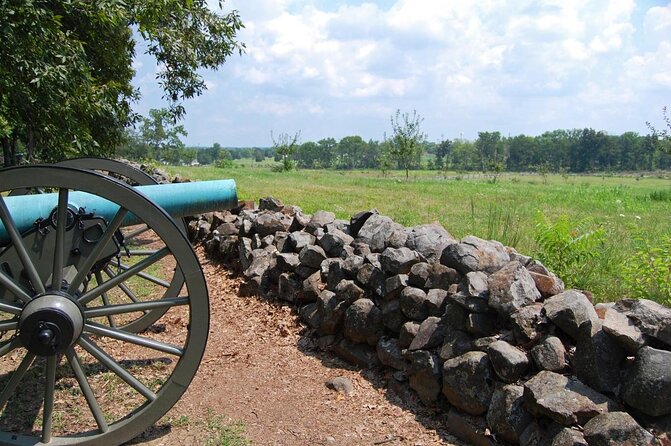
- More than 60 audio stories cover a 19-mile route, connecting the battlefield’s major monuments, ridges, farms, and memorials.
- The narration follows the three days of battle, so you can understand how the fighting moved from McPherson’s Ridge to Pickett’s Charge.
- One purchase covers the whole car, up to four people, making this far cheaper than four individual tickets.
- Download the tour before arrival, while you have strong Wi-Fi or cellular service, since the experience works offline afterward.
- Little Round Top may be experienced virtually, because construction can affect access to the physical site.
- Plan on two to four hours if you stop often, though the driving portion can be completed more quickly.
A battlefield tour that lets you set the pace
The best feature here is control. You are not tied to a departure time, a fixed group, or a guide’s schedule. Start when you are ready, pause when a monument catches your eye, and replay the route on another visit if you still have questions.
The route covers about 19 miles and includes more than 60 audio stories. That is a lot of material for $16.99 per group. If four people share the car, the cost is roughly the price of a snack per person, yet the tour can occupy several hours.
You will need your own vehicle and phone. The app is provided by Action Tour Guide, and the narration is in English. Connect your phone to the car through Bluetooth, USB, or AUX if possible. Apple CarPlay supports audio playback, though map display and Android Auto support may not be available in the same way.
This is not a tour where someone meets you in a parking lot. You open the app at the designated starting point, allow location access, and follow the route. The audio should begin when you reach the first story point, then continue as you drive.
Other routes you can do at your own pace in the USA:
- Fort Sumter Admission and Self-Guided Tour with Roundtrip Ferry
★ 4.5 · 3,343 reviews - San Francisco: Alcatraz Ticket, Ferry, & Self-Guided App
★ 4.5 · 2,460 reviews - Los Angeles: Hop-On Hop-Off Bus Tour with Audio Guide
★ 3.7 · 2,030 reviews
Start at the Heritage Center or National Park Visitor Center
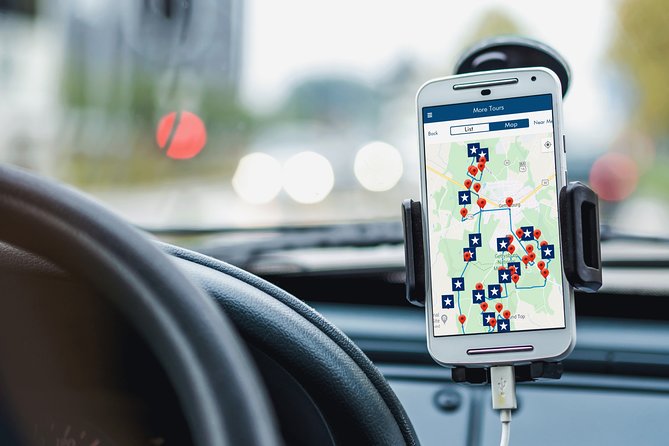
The stated starting point is the Gettysburg Heritage Center parking area at 297 Steinwehr Avenue. The tour can also begin at the National Park Visitor Center. From either point, you join the official Auto Tour route.
The Heritage Center is a useful opening stop because the experience recommends visiting its museum before driving the battlefield. Admission is not included, so treat it as an optional add-on rather than part of the $16.99 tour price.
Give yourself a few minutes to get the app working before pulling out. Search your email and text messages for the setup instructions and password, download the separate Action Tour Guide app, and download the tour while you still have a strong connection. This simple preparation matters more here than it does on an ordinary walking tour because the narration depends on GPS.
A good first test is to start the opening story while parked. If you hear the audio and see the correct route, you are ready. If the app points in the wrong direction, stop and correct it before driving. Several technical complaints came from starting out of sync, missing the start point, or needing to restart the app.
Day One begins at McPherson’s Ridge
The first battlefield section takes you to McPherson’s Ridge, where the opening clash unfolded. The narration helps you picture Union and Confederate units being ordered into position as fighting spread across the ridge.
This is a strong introduction because the battlefield can look deceptively calm. Open fields, roads, and scattered monuments do not explain themselves. The audio gives the ground a purpose and helps you connect the view from the car with the movement of the armies.
Next comes the Railroad Cut, the site of a major first-day skirmish. The route uses this stop to explain battle plans and the decisions made by commanders on both sides. You will also hear personal background about important figures, which keeps the tour from becoming a simple list of troop movements.
The Eternal Light Peace Memorial follows. Its materials carry a clear message: Maine granite forms the base and Alabama limestone forms the pillar, a physical reminder of national reunification. You can pause here to look at the memorial, or keep moving if your schedule is tight.
Oak Ridge and the human side of the battle
At Oak Ridge Observation Tower, the story returns to the afternoon of the first day. The tower offers broad views over the fields, making it one of the better places to stop and look at the terrain that shaped the fighting.
The tour also points out the 11th Pennsylvania Volunteer Infantry Monument. Look for the dog carved on the back of the base. This is Battlefield Sallie, the regiment’s mascot, who accompanied the soldiers through much of the Civil War.
That small detail shows why the personal stories matter. Gettysburg has a huge number of monuments, and it is easy to pass them without knowing what to notice. The audio gives you a reason to stop at particular ones, including the story of military music and the role of drummers during the war.
As evening approaches, the narration explains how Union soldiers lost ground and paid a heavy price on the first day. The generals now had to decide how to hold their positions and prepare for what came next. The route passes the North Carolina Memorial and Virginia Monument before shifting into the second day.
Other audio tours in the USA:
- Medieval Torture Museum Ticket with Audio Guide and Ghost Hunting
★ 5.0 · 962 reviews - Joshua Tree National Park Self-Guided Driving Audio Tour
★ 4.5 · 762 reviews - San Francisco: Alcatraz, Ferry & Audio Tour w/ Night Option
★ 4.4 · 617 reviews - Ultimate Acadia National Park Self-Guided Driving Audio Tour
★ 4.0 · 521 reviews
Day Two reaches its fiercest ground
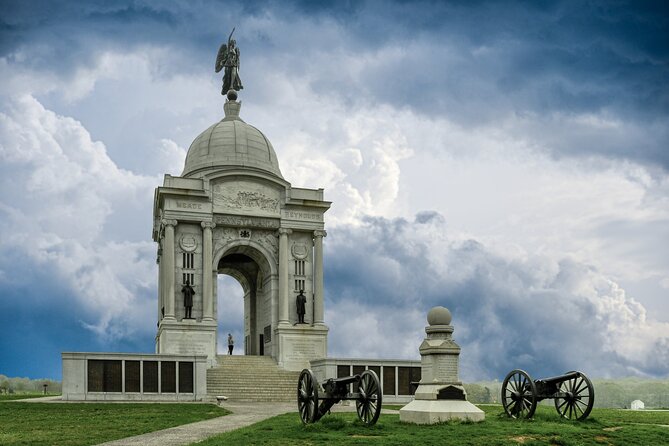
Gettysburg Auto Tour Stop 5 introduces the second day of fighting. This same area later connects with Pickett’s Charge, but the narration saves that final attack for the proper point in the story. That chronological approach helps you follow the battle instead of jumping randomly between famous names.
The Longstreet Observation Tower gives another elevated view over the battlefield. You can also take an optional detour to Eisenhower National Historic Site, the former home where President Dwight Eisenhower often stayed. The detour is useful if you have extra time, but it can stretch the tour beyond the shorter two-hour estimate.
At Warfield Ridge, the audio sets up a Confederate attack against a Union position defended by specially trained marksmen. The next stretch includes Little Round Top and the Valley of Death, two of the most familiar names on the battlefield.
Little Round Top is important because Union soldiers barely held the hill against Confederate forces. The road lets you understand the position from outside, while the narration explains why control of the high ground mattered. At the time of writing, construction may limit physical access, so the tour provides virtual narration and pictures for this location.
Devil’s Den comes next. Its jumble of volcanic rocks gave Confederate sharpshooters cover, allowing them to fire on Union soldiers. Even if you do not linger, this is a place where the physical setting makes the story easier to grasp.
Wheat Field, Peach Orchard, and the farms left behind

The route then moves through the Wheat Field, another major second-day fighting site. The audio places you alongside Union soldiers trying to hold against Confederate attacks and includes the unusual story of Union soldier JJ Purman.
The Peach Orchard follows, where the battle continued with heavy pressure on Union positions. The narration explains which plans worked and which did not, giving you more than a name on a roadside sign.
At the Abraham Trostle Farm, the story shifts from commanders and regiments to civilians. The Trostle family fled so quickly that dinner remained on the table. Details like this make the scale of the battle easier to grasp because you see how quickly military action disrupted ordinary homes.
The drive continues to Plum Run and the George Weikert Farm. The Weikert family also evacuated, but their farm returned to a different role. It became a field hospital, bringing the narration into the work of military doctors and the physical effects of war.
These farm stops are worth your time. They remind you that Gettysburg was not an empty training ground. Families lived among these fields, and the fighting turned homes, barns, and roads into military spaces.
Pennsylvania’s monument and the struggle for Culp’s Hill

The Pennsylvania Memorial honors nearly 35,000 Pennsylvanian soldiers who fought at Gettysburg. The narration makes the local stakes clear: these men were not only fighting for an abstract national cause, but also defending their own state.
Spangler’s Spring is a smaller site, but the tour treats it as an important part of the second day. From there, the route continues toward Culp’s Hill Tower, where Union and Confederate forces fought for control of a strategic position.
The Union held Culp’s Hill until evening. At East Cemetery Hill, the story becomes more tense. Darkness usually brought a pause, but Confederate forces attempted a nighttime attack after failing to fully capture Culp’s Hill.
The narration explains how close the Union came to losing and how perseverance, skill, and luck shaped the outcome. This section rewards a slower pace. Pull over where allowed, look across the ground, and let the audio finish before moving on.
Day Three and the high-water mark
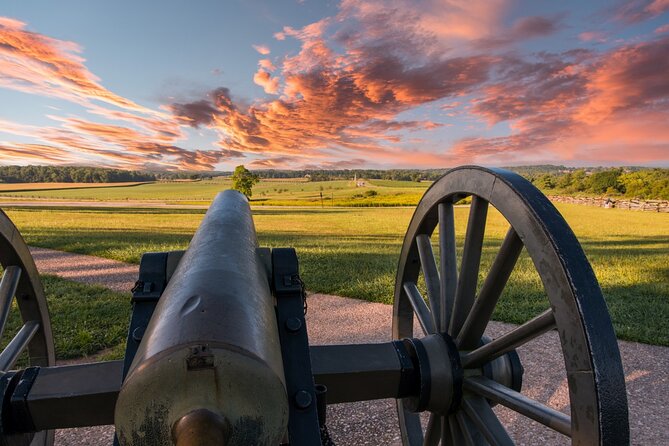
The Gettysburg National Military Park section provides the larger meaning of the battle. Gettysburg ended Robert E. Lee’s second invasion of the North and became known as the High Water Mark of the Rebellion. The battle also inspired Abraham Lincoln’s Gettysburg Address.
The final major battlefield section is Auto Tour Stop 15, where Pickett’s Charge began. From the top of the hill, you look across the open ground that Confederate soldiers had to cross toward Union defenses.
The narration follows the charge and identifies the farthest point reached by the Confederacy, the high-water mark. This is one of the clearest moments on the route because distance does the explaining. You can see how exposed the attacking soldiers were and how difficult the advance must have been.
The next stop, Auto Tour Stop 16, leads to the National Cemetery. The tour ends at the graves of Union soldiers who died defending the position. The final section also explains the Gettysburg Address, including Lincoln’s decision to keep his speech short because he believed the attention belonged to the soldiers buried there.
This is a fitting ending. The route begins with movement, orders, and attacks, then finishes with the cost of the battle.
How the app works in real use
The app is designed to play stories automatically as your location changes. That hands-free approach is useful while driving, and it means you do not need to keep touching the phone at every stop.
Still, GPS is not perfect. The most important practical advice is to follow the marked route, keep to the posted speed limit, and avoid trying to improvise several turns at once. If the audio starts late, repeats, or jumps ahead, stop safely and restart from the correct location.
Download everything before reaching the battlefield. The tour works offline after setup, so you should not need a constant cellular signal. Your phone should run iOS 15 or later, Android 9 or later, or use an iPad or tablet with GPS and cellular capability.
The tour has a lifetime access policy with no expiry, according to the current booking details. That lets you split the route across multiple visits or repeat selected sections on a return trip. One older description of the access period referred to one year, so check the terms shown when you book if long-term access is important to you.
How much time should you allow?
The driving route can take about one to two hours if you make only brief stops. For a better visit, allow two to four hours. The longer estimate gives you time to get out at monuments, walk short distances, take pictures, and listen to extra stories.
You can also pause the tour for food or a side visit. That flexibility is a real advantage over a bus tour, especially if your group includes children, older family members, or anyone who prefers frequent breaks.
The tour ends at 125 Taneytown Road, near the National Cemetery. Plan your day around that final location rather than assuming you will return to the Heritage Center.
Who should book this Gettysburg tour?
I would choose this experience if you want historical context but do not want a fixed group schedule. It works especially well for families, couples, small friend groups, and anyone driving a camper van or private car.
It is also a good choice if you have already driven the battlefield and found the monuments difficult to interpret. The route adds names, dates, personal stories, and battle movements to places that otherwise might blur together.
I would be more cautious if you dislike phone apps or need a guide standing beside you. This is not a substitute for asking live questions, and the GPS system can require patience at the start. You also need to manage parking, driving, and timing yourself.
At $16.99 per group of up to four, the value is strongest when you share the cost. Admission to the Heritage Center, attraction tickets, reservations, and other paid stops are not included, so keep those expenses separate.
Should you book the Gettysburg Battlefield audio tour?
Book it if you want a low-cost, flexible way to understand the full battlefield route. The narration gives structure to all three days of fighting, and the ability to stop at Little Round Top, the farms, the memorials, and the National Cemetery makes the visit feel personal rather than rushed.
Skip it if you want a live historian, a set walking tour, or an experience that requires no technical setup. If you do book, download the app at home or at strong Wi-Fi, test it before driving, and begin at the Heritage Center or National Park Visitor Center.
For most independent visitors with a car, this is a sensible way to see Gettysburg. Just give the app a little patience at the beginning, then let the road and the stories guide your day.
FAQ
How much does the Gettysburg Battlefield Self-Guided Driving Audio Tour cost?
The tour costs $16.99 per group, with up to four people included in one car purchase.
How long does the tour take?
The driving portion takes about one to two hours, while the full experience usually takes two to four hours if you stop to explore and listen.
Where does the tour start?
You can start at the Gettysburg Heritage Center parking area at 297 Steinwehr Avenue or at the National Park Visitor Center.
Where does the tour end?
The tour ends at 125 Taneytown Road near the National Cemetery and the site of the Gettysburg Address.
Is a guide present at the starting point?
No. This is a self-guided activity, so no guide meets you at the start.
What language is available?
The tour is offered in English.
Does the tour work without cellular service?
Yes. You must download the tour while you have strong Wi-Fi or cellular service. After that, the audio and maps work offline.
What phone or tablet do I need?
The recommended devices are an iPhone using iOS 15 or later, an Android device using version 9 or later, or an iPad or tablet with GPS and cellular connectivity.
Can I connect the audio to my car?
Yes. You can connect your phone to the car stereo through Bluetooth, USB, or AUX. Audio playback is compatible with Apple CarPlay.
Are admission tickets included?
No. Attraction passes, entry tickets, and reservations are not included. The listed battlefield stops are free.
Can I pause the tour or use it again later?
Yes. You can pause the tour, take breaks, skip stories, and return to the route later. The current access details state that the tour has lifetime access with no expiry.
What is the cancellation policy?
You can cancel for a full refund up to 24 hours before the experience start time. Cancellations or changes made within 24 hours are not refunded.
Just added in the USA
- Road to Hana: Full-Day Scenic Drive with Blacksand & Waterfalls★ 4.5 · 837 reviews
- Road To Hana: Maui Waterfall Hiking Tour in Private Jeep★ 5.0 · 343 reviews
- Original La Jolla Sea Cave Kayak Tour for Two★ 4.5 · 871 reviews
- Maui Nui Luau at the Sheraton Maui Resort & Spa★ 4.5 · 1,622 reviews
- 2 Hour Sailing Cruise on Lake Tahoe★ 5.0 · 886 reviews
- La Jolla Sea Caves Kayak Tour For Two (Tandem Kayak)★ 4.5 · 1,205 reviews
- Behind-the-Scenes at Petco Park Tour★ 4.5 · 339 reviews
- Key West: All-Inclusive Watersports Adventure with Lunch & Beer★ 4.5 · 351 reviews
Tours in Gettysburg, compared.
2-Hour Gettysburg Battlefield Guided History Bus Tour with a National Park Guide
Read our review →
Civil War Ghosts: Echoes of the Fallen Gettysburg Ghost Tour
Read our review →
Gettysburg: Horse-Drawn Carriage Battlefield Tour
Read our review →
Gettysburg: Ghost Hunt Tour with Ghost Hunting Equipment
Read our review →
Gettysburg: Licensed Guided Battlefield Horseback Tour
Read our review →
Ghost Tour: History and Haunts – Family Friendly – Best in Gettysburg
Read our review →
Browse the lists this tour appears in